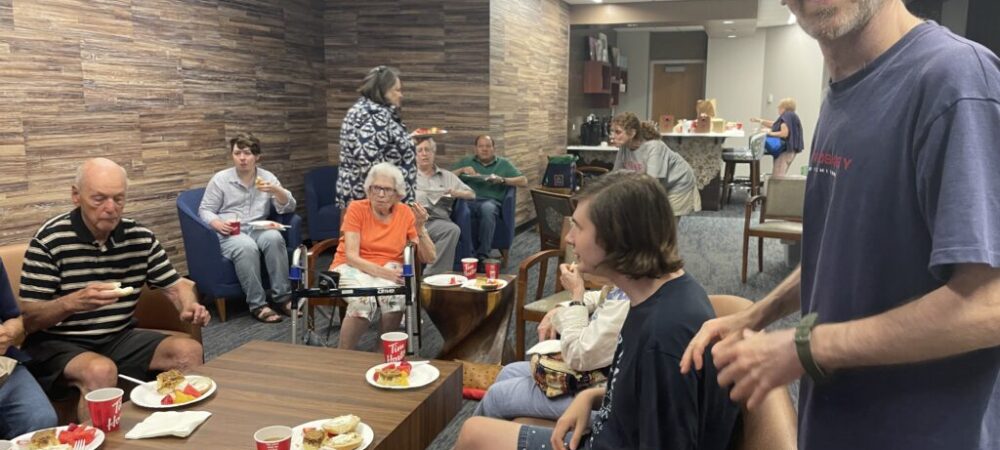
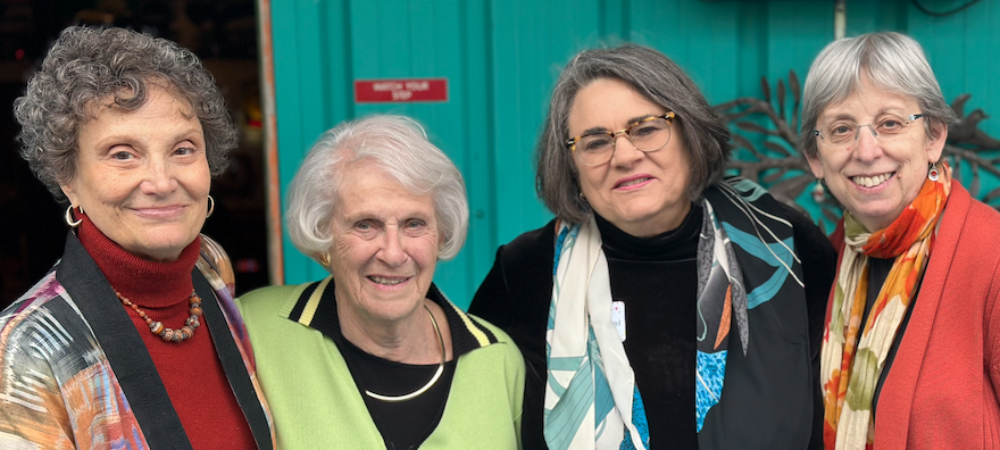
Shalom and thanks for visiting our Temple Emanu-El website. We are a Reform Jewish Congregation in Irondequoit, New York, a few minutes from downtown Rochester.
We feel fortunate that we share a rich heritage, a vital Jewish community life, and a promising future. Our congregation reflects the diversity of today's society - we invite you to share in our warm, informal approach to Reform Judaism
Shabbat services take place on Friday evenings at 8:00 PM, except for the third Friday of the month when they start at 7:30 PM and are followed with a discussion session led by Rabbi Herzbrun. During the summer, all services begin at 7:30 PM.
To find out more about our congregation, please click “About Us” on the menu bar. Better yet, come visit us.
Shavuot, which falls seven weeks after the first night of Passover, has two meanings – as a spiritual holiday it celebrates the giving of the Torah at Sinai; as an agricultural holiday it celebrates spring harvest. The seven weeks correspond to the time of travel from Egypt to Sinai and to the harvest period (barley at Passover and wheat at Shavuot). Thus Shavuot is called the “Festival of Weeks” and also “Pentecost,” the Greek term referring to the fact that the holiday falls on the 50th day following Passover. Shavuot is one of three pilgrimage holidays (the others are Passover and Sukkot) , when in temple times, pilgrims brought offerings to Jerusalem. Shavuot is a Yom Tov on which no work may be done.
During the seven weeks we count the days - the “Counting of the Omer” as commanded in the Torah (Deut:16.9. Tradition has it that the Israelites counted the days in anticipation of the giving of the Torah. The period of the Omer is a period of mourning, because many historical tragedies have taken place during the spring ~ including the martyrdom of rabbi Akiva and his students, the Crusades, with the latest being the last great deportation to the gas chambers during World War II (from Hungary). This is a period of restraint when there should not be any celebrations such as weddings. The one day when mourning is suspended is “Lag B’Omer,” the 33rd day of the Omer.
There are a number of traditions associated with Shavuot:
-- Eating dairy, to symbolize the sweetness of Torah, and the Promised Land’s land being “the land of milk and honey.”
-- Reading the book of Ruth. There is no single reason given, but one explanation is that the story took place at the time of the barley harvest.
-- Study – traditional congregations study though the night until the time for morning prayers:Decorating homes and synagogues with greenery.
-- Confirmation of religious school students.
-- Shavuot is also one of the holidays in which the Yizkor (memorial) prayers are recited.
This year, at Emanu-El we will observe the B’not Mitzvah of five adult students on the Shabbat following Shavuot.
Sources: URJ; Jewish Virtual Library; My Jewish Learning; Wikipedia;
Gerty Cori was the first American woman, and the third woman up to that time, to win a Nobel Prize. The others were Marie Currie and Irène Joliot-Curie. Gerty shared the prize in Physiology or Medicine in 1947 with her husband, Carl Cori, and Bernardo Houssay of Argentina, for their discovery of the course of the catalytic conversion of glycogen (the Cori cycle).
Gerty Theresa Raditz was born into a Jewish family in 1896 in Prague. When she was 16, her uncle, a professor of pediatrics, suggested that she consider a career in medicine. She earned a Doctorate in Medicine from the University of Prague in 1920. While attending medical school, she met Carl Cori, another medical student, who shared her interest in research, the outdoors, and hiking. They were married in 1920 after she converted to Catholicism. During their careers, the couple collaborated in medical research and published some 50 papers together in the field of biochemistry. Gerty also published eleven papers on her own.
In 1922, because of the rise of anti-Semitism, the couple emigrated to the United where they joined the State Institute for the Study of Malignant Diseases (now the Roswell Park Cancer Institute) in Buffalo, NY, he as an assistant pathologist and she as an assistant biochemist. Although the Institute discouraged couples from working together, the Coris continued their collaborations. They became United States citizens in 1928.
Being a woman, Gerty suffered from discrimination in her appointments. Universities would not hire a married couple – they told Gerty that she would hurt her husband’s career. In 1931 they moved to St. Louis where Carl was appointed Chair of the Pharmacology Department at Washington University School of Medicine while Gerty was hired a research assistant at much lower pay. She became a Full Professor of Research Biological Chemistry and Pharmacology at the university just prior to winning the Nobel Prize.
Gerty was honored with a US postal stamp showing the Cori cycle (incorrectly) and having a crater
on the moon named after her. Among the many other honors she was awarded are: The Midwest Award of the American Chemical Society, the Squibb Award in endocrinology, the Garvan Medal, the Women's National Press Award, the Sugar Research Prize of the National Academy of Sciences, and the Borden Foundation Award for outstanding medical research. She received honorary degrees from Smith College, Yale University, and the University of Rochester. In 1948, President Harry S. Truman appointed her as a board member of the National Science Foundation.
In 1947, she was diagnosed with a fatal disease of the bone marrow, myeloschlerosis, but continued her work until her death in 1957.
Sources: Seymour Brody, Jewish Heroes & Heroines of America;
Links: Jewish Virtual Library; Jewish Women’s Archive;
Nobel Prize Website; Wikipedia;